
Rally Report
The Player Who Sought Refuge in Wimbledon
Liesl Herbst excelled in post-Weimar, pre-Nazi Austrian tennis, until she had to flee + More wacky-wild Wimbledon highlights
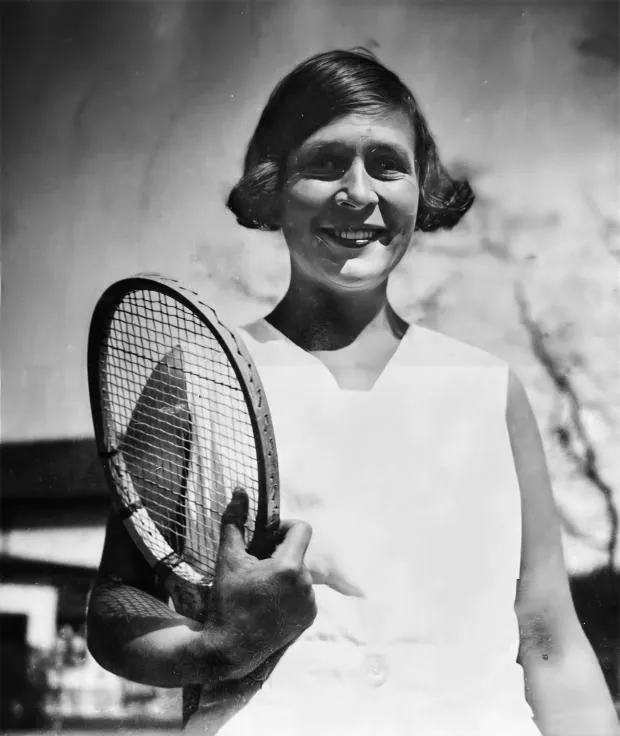
Liesl Herbst, the Austrian National Champion before she escaped Nazi Austria and after a harrowing journey as Europe fell country-by-country, eventually settled in London.
Liesl Herbst had nothing to lose. As Hitler came to power in Germany first and then marched across the former Austro-Hungarian empire in 1938, the Austrian No. 1 tennis player, her husband, David, and daughter, Dorli — after making failed visa attempts for Australia and Portugal — landed in London (David via a snow-covered route across the mountains of Poland). Their new home in Hendon didn’t have quite the opulence or the access as Vienna, and while trying to learn English, find her daughter a proper school and recover from the guilt of leaving her family behind, Herbst fell into a great depression. “Why don’t you try playing tennis again, Liebchen,” David, an athlete himself, encouraged. “Sport will make you happy.”
Stripped of her passport and with only a news clipping to prove her former glory, Herbst questioned her husband’s advice. “I am a German-speaking alien in a country that may soon be at war with Germany,” she replied, according to The Tennis Champion Who Escaped the Nazis: Liesl Herbst’s Journey, from Vienna to Wimbledon. Herbst grumbled some more, but cut ties to her Jewish upbringing and started asking around her London refugee community about a place to play. Luckily, a Hungarian player from her days on tour in Europe offered to sponsor Herbst for a Queen’s Club membership. When the Queen’s Club acceptance letter came through the mailbox, Herbst took the first step all English players had made before her: she caught an Underground train to Lilywhite’s — the famed tennis shop in Picadilly — and bought herself a white tennis dress, socks and trainers.
“But which racquet,” UK journalist Felice Hardy wrote in the book about her grandmother. “ Liesl had left all her sports equipment behind in Vienna and she had no idea what would be the best model and wait for her style of play. Alfred, her coach at Hakoah, would, of course, have known the answer. But Alfred had gone to Dachau (the forced labor camp in Germany).” Herbst faced down a wall display of colourful wooden racquets, dismantled it and emerged with a 1938 Slazenger Fred Perry model. “As she swooped imaginary forehands across the shop floor, it felt clean and swift and, as Fred had won Wimbledon three times, who was she to argue?” Hardy wrote. “It was expensive and she hoped David wouldn’t mind. It was an investment, after all.”

Liesl Herbst (far left) with other tennis players likely from her club in Austria or Czechoslovakia in the 1930s.
Since the establishment of middle-class private tennis clubs in the late 19th century, widespread, whispered antisemitism and rigid English social barriers excluded Jewish players. In response, British Jews began founding their own network of tennis clubs to foster community, sport, and social connection. In the past 80 years that has changed markedly (although openly Jewish doubles champion, Angela Buxton, never received a Wimbledon membership or much English recognition for her support of Althea Gibson) and the All-England Lawn Tennis Club (AELTC) has helped support the careers of a number of tennis greats from countries fraught with conflict, including Damir Dzumhur, the most successful player to represent independent Bosnia and Herzegovina, as well as Ons Jabeur from wild discord in the Middle East, and most recently, Ukrainian players — much to the dismay of Russian and Belarusian athletes in 2023. But even before the emergence of Althea Gibson, the first minority player at Wimbledon, plenty of fringe players have played the AELTC Championships with the club’s unofficial “don’t ask, don’t tell” policy — including Jewish refugee, Liesl Herbst.
More on the Nazi Tennis Escapee, but first… the news

Junior Arthur Fery during a match between USC and Stanford University, where he played NCAA tennis in America before joining the pro tour at the end of 2022.
During one of the wackiest, wild, Kool-Aid-style Wimbledons in recent years, Arthur Fery (ATP No. 114), the first British player to reach the semifinals since Sir Andy Murray in 2013 (who was the first Briton to win Wimbledon since Fred Perry in 1936) has two matches standing between him and the championship cup. The first wildcard to reach the quarterfinal in 25 years beat Italian Flavio Coballi (ATP No. 10 ) 6-4, 7-6 (7-4), 6-0 setting up a showdown with French Open champion Alexander Zverev (ATP No. 3) who bested American Taylor Fritz (ATP No. 7), 6-4, 6-4, 6-2 on Wednesday. Whereas a week ago, odds remained high for an American to win the title for the first time since Pete Sampras prevailed in his final Wimbledon in 1999, none remain a contender following a mind-blowing Saturday in which three of the five American seeds were eliminated. Also on Friday, 39-year-old Novak Djokovic (ATP No. 8), who bested Canadian Felix Auger-Aliassime (ATP No. 4) in five nail-biting sets, 7-6 (12-10), 3-6, 6-3, 6-7 (4-7), 7-6 (10-4). goes 25th Grand Slam title hunting against Jannik Sinner (ATP No. 1), who on Tuesday made easy work of 36-year-old German journeyman Jan-Lennard Struff (ATP No. 74), appearing in his 47th grand slam — the oldest man in the Open Era to reach his first major quarter-final.

Just over a week after beating Naomi Osaka n the Bad Homburg final, Karolina Muchova pulled off a repeat to reach her first Wimbledon semifinal.
The American women had a slightly different outcome. On Tuesday, two of the eight American quarterfinalists, close friends Coco Gauff (WTA No. 7) and Jessica Pegula (WTA No. 4) faced each other with Gauff prevailing in three sets to advance to her first Wimbledon semifinal. Czech all-rounder Karolina Muchova (WTA No. 9), who fights her grass allergy with sprays, drops and tablets, prevailed over tired runway queen Naomi Osaka (WTA No. 14) and then ended the American’s incredible run in a tense three-set match, 6-2, 1-6, 7-6 (12-10). At the other end of the draw, Ukrainian Marta Kostyuk (WTA No. 13) faced another Czech player, Linda Noskova (WTA No. 12), and was handed a straightforward “Na shledanou,” 6-4, 6-4.
Back to the Wimbledon as Refuge…

Liesl Westreich Herbst had grown up comfortably well-off in Ostravia, a prosperous, technically advanced industrial center with the third-largest Jewish community in Czechoslovakia, the daughter of an accountant for and later, partner in the Altvater, a a traditional Central European herbal liqueur. A restless, adventurous young girl, she took up tennis in her youth and then started taking it seriously after meeting her husband, David Herbst, a successful hosier in Vienna, and giving birth to their daughter, Dorli. In 1928, Liesl embarked on an intense round of training with coach Alfred Schönfeld at the Sport Club Hakoah Wien (Hakoah means “the strength” in Hebrew), a Jewish sports club in Vienna. David Herbst came to all her matches.
Soon, the additional training paid off and in two years had became the national tennis champion of Austria, notching tournament championship wins in several regions of Austria, as well as the nearby countries Yof ugoslavia, Italy, Czechoslovakia, Poland, Hungary, France, Switzerland, Germany, Greece, and Egypt. Between 1930 and 1936, the Austrian Lawn Tennis Association didn’t send any female representatives to Wimbledon or to Roland Garros, Herbst nonetheless played — and won — matches against several Grand Slam champions and international stars, including Helen Jacobs of U.S., Simone Mathieu of France, and Hilde Krahwinkel Sperling of Germany and Denmark. Herbst played mixed double with almost every Austrian Davis Cup player of that era.
“Frau Liesl Herbst arrives in her Mercedes-Benz car which she drives herself — she was one of the first female car drivers in Vienna — arriving straight from the tennis court on which she practices for about three hours a day in order to stay in good shape,” according to the Neues Wiener Journal in an article dated 3 August 1930. “ She stared late with tennis even though she was known to be keen on sport in her youth… ‘After the birth of my child, I looked unwell and had no appetite. That is when the doctor and my husband advised me to play tennis. So I took a racquet and started.” From 1930 and 1937, Herbst participated in more than 70 tournaments in Austria, but beginning in 1938, on her walks back-and-forth to the tennis club, she began to see more and more SS soldiers in Vienna, as well as witness significant atrocities. In the next three months, the writing was on the wall: David began applying for visas for his family to Portugal and then Australia.

Lisel Herbst ready to hit an overhead smash at the he Sport Club Hakoah Wien in the early 1930s before Hitler invaded and annexed Austria during the Anschluss campaign in March 1938.
Although the governments of nearby countries opposed the Third Reich, they were reluctant to take in refugees. Herbst’s tennis prowess proved useful enough for a temporary passage to Prague, where she and Dorli boarded a flight to London on 9 February 1939, leaving David to find his way across Poland and meet them months later.
Following Herbst’s Lilywhite’s adventure, in which she bought three Slazenger Fred Perry models, she made her way to the Queen’s Club and made influential friends. Although she had not hit a tennis ball in two years, her new compatriots instantly noticed her ability and once she told them that she had been a tennis champion in Austria — without revealing her Jewish roots — they urged her to apply to play the 1939 Wimbledon Championships. Unable to receive a wildcard to the main draw, Herbst beat three different opponents over three days in the Wimbledon qualifiers, including Susan Billington, the grandmother of Tim Henman — her last set won by a margin of 13-11 games. When it ended, she reached into the pocket of her husband and took a one-pound note and two half-crown coins to pay her entry fee into Wimbledon. “(Herbst) told herself that it wouldn’t matter who (she faced on the first Monday of the Championships). The victory was already hers. She had won the right to be one of the 128 women to take part.”
Her opponent for the first round of Herbst’s first Wimbledon was Valerie Scout, 15 years younger and a previous Junior Wimbledon champion. Herbst would not go home to Hendon the victor that day, but she told David, “I thought I would be unhappy at being beaten like that, but I’m not. Since Papa gave me that racquet all those years ago, I have dreamed of winning Wimbledon. But as I grew up, met you and lived our life together in Vienna, the dream changed shape.”

Liesl Herbst as a child (seated) surrounded by her family, the Westreichs in Krnov, Silesia, now a region encompassing Poland, as well as parts of the Czech Republic and Germany. Her family owned the Gessler distillery, which made Altvater, a traditional Central European herbal liqueur. All but Lisel perished during World War II.
So did Wimbledon after Germany dropped two bombs on the club on 11 October 1940. Herbst would not return to play doubles the following yeat, or the following or even the next. In fact, Herbst and her husband turned most of their attention to saving their families back in Austia and to their daughter, Dorli, by then on her way to becoming a champion tennis player in her own right. The next time Herbst set foot on the hallowed court was summer 1946 to play doubles with Dorli; Dorli competed in the Ladies Singles at Wimbledon that year, as well as 1947 and 1948.
Herbst ultimately lost both her beloved sisters and her mother during World War II — her mother and one sister at the Terezin concentration camp and the other during the Slovak National Uprising. Dorli was naturalised in 1947 and married Philip Mills, a lawyer in 1954, ultimately leaving him a few years later and succumbing to lung cancer in 1978. Liesl went on to live another 12 years, enjoying the game of galf; she died in 1990, aged 86.
“Liesl lost her main playing years because of the war,” Hardy, Liesl’s grandaughter told The Jewish News. “… My grandmother never got that far at Wimbledon, but she was 35 and it was the first time she had played on grass.
“Liesl’s and Dorli’s) record of being the only mother and daughter to have played doubles together at Wimbledon is unlikely to be broken because it was an amateur sport then and you could be playing at 40… “Initially, I wanted to write the story for (my children) and their children, but then I told some friends, and they assured me that other people would be interested…. It is so important for families to talk about the past, find out more, and pass it on.”

RALLY SMASHES: The Freddie Krivine Initiative
Since its founding in 2000 the Freddie Krivine Initiative (FKI) has been dedicated to enhancing and strengthening the values of education, equality and social inclusion for Arab youth in Israel through the sport of tennis. Krivine, a UK-born businessman and philanthropist who had a life-long passion for two things — tennis and improving Jewish-Arab relations — died in 2015. But beginning in 1984, when he and his wife, Shelagh, went to live in Israel he first funded women’s tennis in the country, became president of the Israel Tennis Association and then, in 2000, launched the first Arab-Jewish tennis group for children aged up to 15 years old. Since that time, the initiative has produced several successful junior players and Arab tennis coaches.

Serena Williams ponders her next move during her ultimate first-round Wimbledon upset on Centre Court. She lost to 20-year-old Australian Maya Joint, 3-6, 7-6 (8-6), 3-6.
RALLY SHANKS: Serena’s Wasted Wildcards
Despite popular belief, most greats who retire don’t go gently into their goodnights. Retired is a state of mind, not a job position. Former pros become tournament directors, tennis commentators, association officials, podcasters and foundation leaders, all with time to spare to play Grand Slam exhibitions — and still have their egos stroked. After accepting doubles wildcards into the HSBC Tennis Championships, the Berlin Open and Wimbledon, Serena Williams waited a week before accepting a singles wildcard so that her “children could see me play” — much to the chagrin of many players grinding it out on the ITF World and the WTA “challengers” tours. She lost the first round to one of those WTA challengers, Maya Joint, despite stretching it to three sets, injured her knee, skipped the press conference after — an obligatory Wimbledon “ask” — and headed home after pulling out of the doubles. Here’s a suggestion, Williams sisters and Grand Slam tournaments: instead of saving those wildcards for former greats, why not hand them to up-and-comers from former Commonwealth countries or players from MENA and sub-Saharan Africa climbing the ranks from ball-”pickers” who have neither the money nor the clout to make it to Western championships.

Scenes from a sunny day at the Cumberland Club, including (clockwise from top left): court score-keepers, the lush grass in June, the old-fashioned court time-keeper and a tennis event during Wimbledon 2024.
TENNIS CLUB OF THE WEEK: The Cumberland Club
Every club in the London area vies for the title of first lawn tennis club, or oldest lawn tennis club. Wimbledon usually takes the prize, but some come fairly close, including the Queens Club and the Cumberland Club, just over the line from Camden and into Hampstead. Founded in 1880, Cumberland’s main site has 12 courts, including five acrylic (not the fast-drying, yet crummy madacam asphalt of most English hard courts) three artificial clay and four natural grass (in season). But Cumberland members also have access to eight additional tennis courts run by the Hampstead Cricket Club through a joint partnership. Cumberland also has one of the best club teams in England, with touring pros at the top tier and former college and country champions on the lower levels. If bored with Wimbledon, grab the District Line north and the 328 bus, and boom, a new field of grass awaits.



BY Adrian Brune
READING TIME : 8 MINUTES
Related articles…
China’s Tennis Town
Rally Report
BY Fanfei Ye
READING TIME : 8 MINUTES
US Open = Disneyland of Tennis?
Rally Report
BY Ana G. Canahuate Torres De Castagno
READING TIME : 8 MINUTES
NCAA International Tennis Athletes v. the New Anti-Immigrant American Zeitgeist
Rally Report
BY Ana Gabriela Canahuate Torres
READING TIME : 8 MINUTES
SEE ALL RELATED ARTICLES
Same author
China’s Tennis Town
Rally Report
BY Fanfei Ye
READING TIME : 8 MINUTES
US Open = Disneyland of Tennis?
Rally Report
BY Ana G. Canahuate Torres De Castagno
READING TIME : 8 MINUTES
NCAA International Tennis Athletes v. the New Anti-Immigrant American Zeitgeist
Rally Report
BY Ana Gabriela Canahuate Torres
READING TIME : 8 MINUTES
SEE ALL ARTICLES BY THIS AUTHOR