
Rally Report
Tennis, Futterman Concludes, is Sport’s Cruelest Game
But it does have a few merits, according to “The Athletic” tennis writer, whose book chronicles the “codes” — as well as the “catches” — of cracking the top.

Matthew Futterman (left) the tennis writer for The Athletic (formerly the New York Times sports department) and his most recent book about the increasing demands of pro tennis.
Matthew Futterman was fresh and in good form two weeks ago, the day before the first week of a three-week stretch of reporting on the U.S. Open. He had a good hit the night before at his favourite courts at 114th and Riverside — still relatively hidden to the ravenous New York tennis crowd — and with one of his best tennis buddies from his teenage playing days in Rye, New York.
Unlike his predecessor and colleague at the former New York Times sports desk (now The Athletic), Christopher Clarey — the West Coast tennis “army brat” once called “the doyen of English-language tennis journalism” by the Times of London — Futterman, with a slight build, a full-head of greying locks and a schoolboy’s enthusiasm, grew up a native New Yorker, admiring and even playing against some of the big hitters at Mamaroneck High School and Rye Racquet Club : Peter Fleming, Patrick McEnroe, Jill Smoller, and their contemporaries. “Melissa Brown, one of my instructors, told my mother when I was 11 that I should be spending weekends playing junior tournaments,” Futterman said in a call from his home in New York. “My mother said ‘I’m not spending all my weekends driving you all over New York and New England.’”
“But I grew up in a super star tennis town, like the John Hughes version of tennis. It was funny. I wasn’t really good enough to play for the high school team, but Mamaroneck definitely wasn’t the typical high school team — run by the assistant football coach who just assigned the No. 2 and the No. 6.” Instead, Futterman said with a laugh, he went on to compete at Union College, a NCAA D-3 in upstate New York before attending Columbia Journalism School and starting his sportswriting career at the Star-Ledger of New Jersey. Since then, Futterman — a marathoner in his spare time — has reported for the Wall Street Journal and the Philadelphia Inquirer and written two other books about running and the sports business. Futterman sat down with RALLY from his home on the Upper West Side to talk about the inspiration for his most recent book.

The ATP Tour Finals in Turin in 2022 — the first year it moved from London — and the end of the road for the tennis calendar year.
RALLY: Tennis has come a long way since you and I were playing high school and hoping to get picked up by a college. Are these good ol’ days of high school standouts and convincing coaches you deserve a chance gone?
Matthew Futterman (MF): They are certainly gone in the sense that the great ones aren’t playing for high school teams anymore, or even really, really good regional club teams. My daughters play high school tennis in New York and its a pretty low-key experience — not the highest quality of play. There is 100 percent a tennis industrial complex that has grown up around the sport — it’s been professionalised. But possibly not for the right reasons? There is so much money at stake these days, and that seems to be what most people are chasing: the money and the life.
But all sports has gone through this; it doesn’t mean that there isn’t any fun to be had anymore. But the professionals are hard core. And Borg and McEnroe at Studio 54 looked to be having more fun than what you see these days.
RALLY: So who is having fun and who is grinding it out?
MF: Well, it’s not like no one is having any fun at all. But no one is as disciplined as Novak (Djokovic). The guy’s body is a temple — no sugar, low carbs, barely any alcohol. You try eating avocado ice cream for a month. Sabalenka’s team has to keep bags of sour patches and Haribo away from her or she will just snatch it and put her off her entire regime. It’s hard to live like that.

An influencer with a portable camera light and a Honey Deuce in the same hand ready for her 15 minutes during a night match; Naomi Osaka, in Alan Iverson-inspired kit, shrugged it off but noted “the umpire told everyone to be quiet — more than I’ve ever heard an umpire tell a crowd to be quiet.”
More on the Cruelest Game but first… the “Zoo York” Open
In 2006, immediately before the Big Two — Federer and Nadal — and then the Big Three (Djokovic) started dominating tennis, the U.S. Open needed a little zip, a little zing during that shoulder season following the retirements of Agassi, Sampras and Courier. USTA Marketing and Grey Goose tapped restaurateur Nick Mautone of Gramercy Tavern to come up with a signature drink for the last Slam of the Season. And thus, the Honey Deuce. Since then, the drink has almost overlapped the tournament in popularity — and set in motion the corporate party that would eventually envelope the event. Five years ago, the U.S. Open sold more than one million Honey Deuces across the previous four tournament; last year, fans slammed back 738,459 at $23 a pop—roughly one Honey Deuce for every second the gates were open.
Whether it’s the drink effects, the post-Covid hangover, the continually rising popularity of the sport, or the ideal of the “lux lifestyle,” the Honey Deuce represents the U.S. Open’s new “block party” reputation. Do the players like it better than the empty stands of six years ago? “I feel like it could be a good thing for people to make the sport of tennis popular to their specific audience, but I think it has to be managed a lot better, especially in the situation like [my] first-round match,” said Naomi Osaka (WTA No. 13), who is crawling her way back to the top after motherhood and time off. “Overall, I think there is huge positives… I just think it has to be in a way that everyone knows the rules and the etiquette… the umpire told everyone to be quiet — more than I’ve ever heard an umpire tell a crowd to be quiet.”

Does the City of New York, the USTA and U.S. Open fans want overfilled stadiums of fans and influencers as this past two weeks or prefer more serenity, as in 2020?
If the influencers, the parties, the noise of Arthur Ashe, and the city haven’t proved overwhelming for players, then the rain and marijuana — and reporters’ questions — have possibly pushed their limit, or at least Aryna Sabalenka’s (WTA No. 1). While Greek player Stefanos Tsitsipas (ATP No. 53) may have finally found his form after a serious drought, and four English players, including Francesca Jones (WTA No. 104), Harriet Dart (WTA No. 131) and Jacob Fearnley (ATP No. 101) were able to stow themselves enough from the very non-Centre-Court environment to prevail past the first round. The king- and queen-killers of the summer — Arthur Fery (ATP No. 33) and Maja Chwalinska (WTA No. 22) — possibly proved one-hit wonders, as they haven’t lived up to the next “great hopes,” either. Stan “the Man” Wawrinka, after being nearly denied a wildcard, did receive his U.S. Open retirement party, and Gael Monfils (ATP No. 311) played some of the best tennis of his late career before announcing he would go into “finance” now that he is done. The power of the top seeds — Alexander Zverev (ATP No. 2), Carlos Alcaraz (ATP No. 3) and Ben Shelton (ATP No. 9) — remains strong, however, as does that of the Americans. Jessica Pegula (WTA No. 3) and Coco Gauff (WTA No. 4) who pretty much cruised to easy wins so far — aside from the f-bombs on the doubles court for a dodgy let call. Emma Navarro (WTA No. 27) found her form again, taking out Karolina Muchova (WTA No. 7). Madison Keys (WTA No. 24) looked as if she would survive another close match — after winning a third-set, 10-point tiebreaks in the second round — but possibly the noise, crowds, Honey Deuces and weed got to her in the end. The mentally tough, no prisoners taken Qinwen Zheng (WTA No. 121) crawled back from a five-game deficit in her third set with Keys to unlock her way into the Fourth Round. Will an American man keep the Tiffany Trophy at home — the first since Andy Roddick in 2003 — and Gauff seize it back from Sabalenka? The USTA certainly hopes its Honey Deuce has finally paid off.
Back to the Mercilessness of Tennis
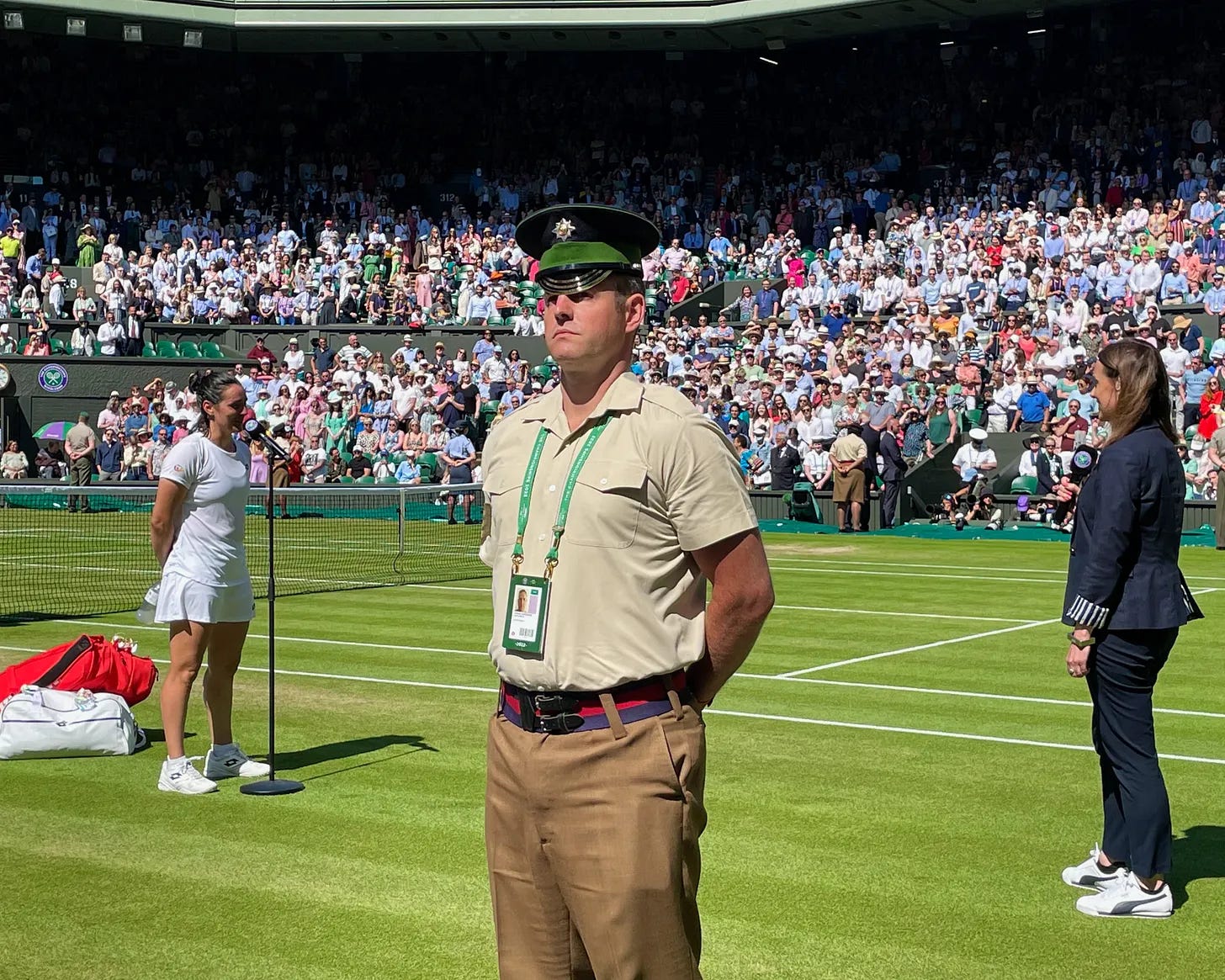
A Matthew Futterman view of Wimbledon, Centre Court, 2022. Talk about merciless. Jabeur, the first Arab female to make the Top 25, Top 10 and Top 2, made it to the Wimbledon final in 2022 and then 2023 before losing her nerve to Elena Rybakina (WTA No. 2) and Markéta Vondroušová (WTA No. 153).
RALLY: You’re more into running marathons these days. How did you come to take over the tennis desk and then come up with your book thesis?
MF: I became a full-time tennis writer for the Times and now The Athletic in 2020, but before that, I was investigative sports writer for several newspapers, including the Wall Street Journal. In 2008, we didn’t have a full-time tennis writer, so it was an all-hands-on-deck situation covering all the tournaments. I switched over and worked as an editor for two years, but wasn’t happy and my good friend (the late tennis writer) Tom Perrotta said “why don’t you write again? Come and help me cover the Open.” I did. During the course of the next couple of years, I saw all these top players who were losing their minds and on the verge of quitting — and Ash Barty did quit — and just walking away when they should have been playing five, ten more years. They were leaving their careers, all they’d known, all this money on the table. I started thinking “why is this sport different? What makes it so difficult that someone would give it all up in a minute?” I put together a proposal, and dashed off this title about the cruelest game on deadline and it sold.

Novak Djokovic at the Regents Street Lacoste store in June 2022. Djokovic, one of Futterman’s main characters, proves full of anecdotes and contradictions — and a master of “the codes” of tennis success.
RALLY: So… what did you conclude? What’s with the burnout?
MF: In order to reach the top, these players have to start on the path when they are six or eight years old — a vast majority of them switch to online school. They spend most of their time around adults or other players who may be friendly, but will rip their throats out on a Thursday to win, which, to be honest, is not the greatest foundation for a friendship. They are getting primed for a path where there are only 60 or so best jobs in the world; their parents are spending everything on them, often at the cost of the other siblings. If they don’t reach the top, they wonder if the closest people to them — a team of people whose lives completely rely on their success — will still love them. They’re on court alone; they’re often losing alone. Because let’s face it, this is a sport in which the best travel ten months a year and lose every other week — it’s built on failure. I would say that’s a tough gig and that’s before anyone factors in the physical demands of the game: having the stamina of a marathoner, the lungs of a sprinter and the coordination of a dancer.
RALLY: That sounds pretty bleak. Why does anyone do it then?
MF: There is no better feeling in sport — to me, anyway — than the feeling of a tennis ball on your strings especially when you hit it true. And there is nothing quite like the feeling like winning a tennis match, even just a match down the street against the worst player on the block. It’s a hit of something, serotonin, adrenaline, dopamine… For women, it’s the highest paid sport and a tremendous amount of money to turn away from.
RALLY: What’s the worst-case scenario?
MF: How far into the book are you?
RALLY: About chapter three or four?
MF: From the beginning, Qinwen Zheng was beating everyone in her small city. Her dad drives her down to Wuhan and tells her she is going to play in front of a coach, but he doesn’t tell her he’s going to leave her if the academy wants her. Time comes, he waves goodbye and she has no idea what is happening to her. She cried; she begged to go home. Every two weeks her parents came and visited, but they still wouldn’t take her home. I mean, don’t abandon your six-year-old with a strange man — is that really good parenting? At 12, she moved to Beijing, and then she went to Spain. It paid off, I guess. But it’s like Andre Agassi has said about tennis parenting — and I am paraphrasing here: It’s not enough when your kid loses to pat them on back and tell them they will be alright or celebrate like crazy when they win. You sit on your hands and tell them you love them whether they win or lose. Same with the coaches. I don’t want to say whether having your partner as your coach is optimal, but Madison Keys has said that her now husband allows her to play true to herself. What she needed most was the permission to lose and someone to tell her exactly what she needed and not just what they thought she wanted to hear.

Iga Świątek practicing on Court Philippe-Chatrier before the 2022 French Open, which she would go on to win — the her third slam.
RALLY: How do you keep doing it, then?
MF: I try to write about life and people and tennis provides a rich canvas through which to explore lots of different human emotions. I do like this sport — I like the individualism. It’s not unique to tennis, but I am drawn to individual sports — maybe it’s why I’m marathoning.
I think I am liked alright among the tennis writers. I have a reputation as being tough fair and empathetic. I don’t take cheap shots; I don’t do drive-bys. I am not a columnist; I give them a chance to speak. I don’t ask someone to explain their five-hour loss at 1:30 in the morning. Whoever they are and wherever they are from, I would say that most have had a pretty rough upbringing — it’s not really something I would have wanted for myself, especially now that I am older.
RALLY: Okay, now is the cliche question. Who is your favourite player?
MF: What, now? Or throughout history?
RALLY: Both, why not?
MF: My absolute favourite was Vitas Gerulaitis. I was from New York; he was the ultimate New Yorker. McEnroe was untouchable. Vitas was goofy and funny and hugely talented. Those players were practically playing in my backyard, training at the Port Washington Tennis Academy just across Long Island Sound. To be a kid in that era of American tennis was incredible.
The evolution of Novak Djokovic from the time when he was a flakey 20-year-old, when he was quite guarded and hard to get to know, then becoming the disrupter, and then getting to know him has been quite a ride. I have become very familiar with his curiosity — and I say this as someone who disagrees with him on a few things — and he is incredibly intelligent. Getting to know him in that way and just his sort of politeness and exceptional generosity… I don’t think I would have predicted in 2007 that he would ever be this great complicated character who is very self-aware of his complications and contradictions, which makes him probably one of the most human of them all.
The Cruelest Game (Doubleday, 342 pages) is currently available online or at your nearest local bookstore.

The Yumi Heo faceted glass installation Q is for Queens at the 40th/Lowery Streets. ‘O stands for Open’ as in the U.S Open. Heo;s work covers three stops on the 7 train out to the BJK Tennis Center.
RALLY SMASHES: 33RD/RAWSON STREETS: Q is for Queens (1999) by Yumi Heo
While the 7 train goes underground through Manhattan, it goes elevated as it travels through Queens, landing on a succession of stations in one of the most ethnically diverse areas of the city. The renovation of the train brought out artist and illustrator Yumi Heo (1964-2016), to design 30 faceted-glass panels for the new stations. Collectively titled Q is for Queens, the brightly colored windscreens use each letter of the alphabet in a narrative that brings Queens history to commuters. Located on three stations in Sunnyside, the first installation at 33rd/Rawson Streets comprises A through J depicted by such landmarks as the Aqueduct Racetrack and Dragon Boat races. The next station, 40th/Lowery Streets includes the letters K through P, and portrays event such as the Chinese New Year and the U.S. Open — “O is for Open” Lastly, 46th/Bliss Streets highlights the letters Q through Z through royal costumes to represent the borough’s origin, as well as Stealing Bases for the New York Mets. A native of Korea who came to New York to study at the School of Visual Arts, Heo made New York her permanent home and created more than 30 distinctive books praised for their stylized, whimsical imagery. Heo died at age 52 in 2016 after a long battle with cancer. Read more about it in The Art of the New York City Subway, coming out on 19 November (Quarto Books).

RALLY SHANKS: Betting Company Sponsors vs. Williams’ Post-Match Non-Presser
Could Kalshi, the U.S. Open’s “prediction market” partner have accurately guessed that the Willams sisters would lose their first-round doubles match to Maya Joint and Hao-Ching Chan? Probably. It doesn’t take a complex algorithm to factor in age, fitness, tour suitability and time on court. Even someone three Honey Deuces deep might have seen it coming. Could Kalshi have bet — ahem, predicted in the tennis market — that it would mark Joint’s second time to defeat Serena times two in the course of two months? On tennis’ greatest stage? Doubtful. That stat is just too weird. Then what is Kalshi doing as an “official” sponsor of an event that has been wrecked by betting, especially on the women’s tour? Online bullying, stalking, match-fixing, harassment — all of these things have been called out a thousand times by players — and even contributed to their leaving the sport prematurely. But could Kalshi have helped betters wager on whether the Williams sisters would skip out on their obligatory post-match pressor, an obligation for all players, especially the receivers of wildcards? That one is easy. They seem willing to pay the $50k fine to walk off, if it gets charged.

The fancy clubhouse and perfectly manicured grass courts of the Orange Lawn Tennis Club. No Sopranos in sight…
TENNIS CLUB OF THE WEEK: The Orange Lawn Tennis Club
Orange Lawn Tennis Club: While it’s not exactly true that the Orange Lawn Tennis Club is one of the “few remaining grass court clubs” in the world (England, West Side, anyone?), grass is, indeed, dwindling as a sustainable surface. Too little care for the future in the Gilded Age? Perhaps. But the Orange Lawn Tennis Club, just a bit west of Newark, has many surface choices, including Har-Tru and good ol’ acrylic. This little haven in West Orange also offers cardio tennis workouts to intermediate and advanced instruction, clinics and tournaments. In other words, it’s like an traditional neighbourhood English tennis club, only about ten times more expensive, as all American “country clubs”. Still, the club is bubbled in winter, membership discounts apply and the club claims to have “produced legends including John McEnroe and other luminaries of the game.” @JohnnyMac care to comment?

Stefanos Tsitsipas playing a pre-Open warmup at the Winston-Salem Open in late August.
The Althea Effect: Stefanos Tsitsipas (Part 3)
Winning is the objective of professional sport.
But what if focusing too much on winning today gets in the way of becoming better tomorrow?
Improvement requires discomfort. Experimentation. Taking risks. Sometimes even losing while you're learning something new.
That's not just tennis. It's coaching. Art. Filmmaking. Business. Life.
But something else stayed with me from my conversation with Stefanos…
Words and pictures by Rex Miller



BY Adrian Brune
READING TIME : 8 MINUTES
Related articles…
NCAA International Tennis Athletes v. the New Anti-Immigrant American Zeitgeist
Rally Report
BY Ana Gabriela Canahuate Torres
READING TIME : 8 MINUTES
Losing the Line Umpires + Ask the Buttery
Rally Report
BY William “Bill” Coles
READING TIME : 5 MINUTES
11 September 2026: 25th U.S. Open 9/11 Editon
Rally Report
BY Adrian Brune
READING TIME : 8 MINUTES
SEE ALL RELATED ARTICLES
Same author
NCAA International Tennis Athletes v. the New Anti-Immigrant American Zeitgeist
Rally Report
BY Ana Gabriela Canahuate Torres
READING TIME : 8 MINUTES
Losing the Line Umpires + Ask the Buttery
Rally Report
BY William “Bill” Coles
READING TIME : 5 MINUTES
11 September 2026: 25th U.S. Open 9/11 Editon
Rally Report
BY Adrian Brune
READING TIME : 8 MINUTES
SEE ALL ARTICLES BY THIS AUTHOR