Rally Report
The Althea Effect
A new RALLY Report feature by tennis player and renowned cinematographer, Rex Miller

Above, two of Rex Miller’s most talked-about films, Althea and Citizen Ashe. Althea, who played against Miller’s mother helped inspire Miller to pursue storytelling and tennis.
What happens when somebody expands what’s possible?
It’s the question that Rex Miller has been asking since he was the kid in the crib next to the tennis court, as his fanatic parents played their weekend tennis matches. He had the same thought playing juniors out of New York in the 70s, mingled with Jimmy Arias, Paul Annacone, the McEnroes and went on to captain the D1 Colgate varsity tennis team.
Miller, who still coaches (with EMPACT Tennis in Durham, NC, his home since his "escape from New York”) finally started to get answers to his question when he pursued a career as a visual storyteller with an extensive background in photography and filmmaking, being part of 5 Peabody-awarded projects and multiple nominations for Emmy awards for Cinematography. Miller, who identifies as multiracial, has directed, produced and shot seven feature documentaries around Tennis, including Althea (PBS/Amazon) and Citizen Ashe, co-directed with Sam Pollard (CNNFilms/HBO).
Now with his project, The Althea Effect, Miller continues to elaborate on people who push the boundaries, think outside the box, stretch their minds, dive headfirst into the unknown. Miller’s short docs will appear on his YouTube channel and the Rally Racquet website starting next month.
On July 6, 1957, Althea Gibson claimed the women’s singles tennis title at Wimbledon and becomes the first African American to win a championship at London’s All England Lawn Tennis and Croquet Club (AELTC) defeating Darlene Hard, 6-3, 6-2. But this was just the beginning of Althea Gibson’s story. Miller’s connection to Althea Gibson started before he was born, however. Miller began searching for Althea’s story because of a photograph that hung on the wall of his childhood bedroom. Taken in 1958, it shows two brown-skinned women, dressed in their tennis whites, holding tennis rackets and standing on the front lawn of the Merion Cricket Club, a prestigious and highly restricted tennis club outside of Philadelphia. Neither woman could become a member because of segregation, but because of their playing skills they were allowed to play the tournament. One woman was his mother, Millicent Carrington Miller. The other was Althea Gibson.
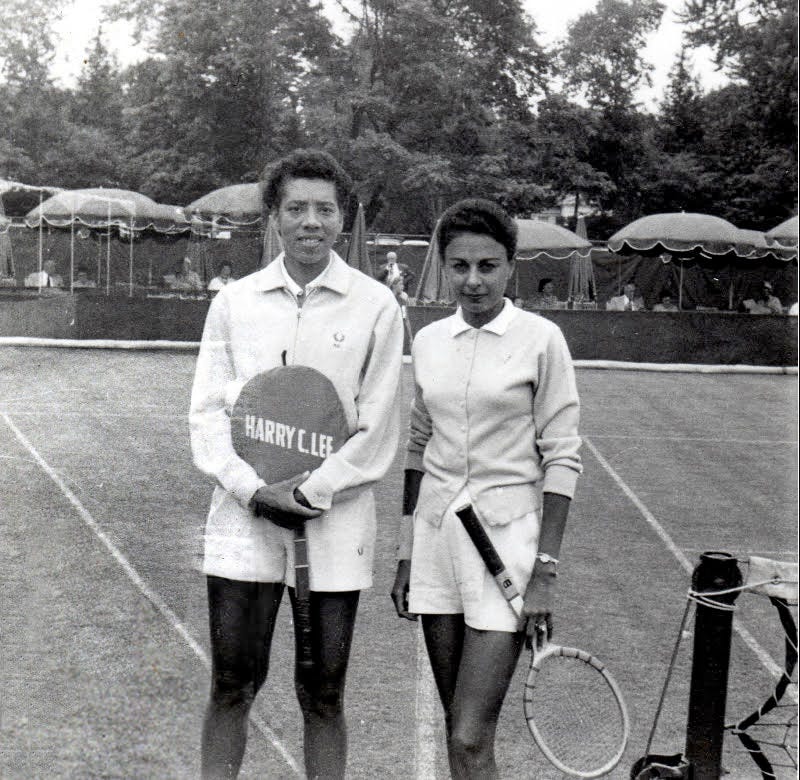
Althea Gibson and Miller’s Jamaican mother, Millicent Miller, ca. 1958, at Merion Cricket Club, Philadelphia.
Says Miller: “This was my mom’s moment of tennis glory, a story I heard many (many, many, many!!!) times. My mom was a good local player and Althea had just won her second Wimbledon. Mom lost 0 and 1 and it was her favorite Tennis memory, by far. Years later, re-discovering this photo lead me to take a look at the details of Althea’s life, which I found more and more compelling as I peeled back the layers, which just kept coming.”
Rex: “For me, this journey around The Althea Effect, it’s about the storytelling. Visual storytelling.
The Althea Effect:
For me, it resonates as:
What happens when somebody expands what’s possible?
That’s a question I am fascinated by.
The who, what, when, where and how. And then, of course, there’s The Why.
I’ve had a lifelong fascination with people who pursue their potential at the highest level,
stretching the boundaries of what’s possible
Through my lens, I share “Notes from a Cinematographer”, my experience seeing “human potential observed at close range.”
Could be the subject is Althea Gibson.
Could be Spencer Haywood.
Sometimes it’s South Sudan.
Novak Djokovic.
Jordan Lee.
The Althea Effect is NOT a tennis publication.
I don’t even think it’s becoming a sports publication.
I think it’s becoming a publication about human potential observed at close range.
The Althea Effect project of storytelling came about through a collaboration of 15 years with the Pershing Foundation.
Next year will be Althea’s 100th birthday. This is one of several initiatives that will highlight Althea’s story and what she stands for.

Miller on location in Lynchburg, VA, 2018, filming Jelani Sarr for his film, “Citizen Ashe.”

Venus Williams exited the first round of the Cincinnati Open after losing her first round doubles with sister Serena — the sisters’ long-awaited revival. They are set to play the US Open.
More on the Effect of Althea Gibson, but first… Oh Cincinnati!
Quite possibly one of the best stories the New York Times ever ran on the Cincinnati Open, aka the Western + Southern Open, and now back to just plain ol’ Cincinnati (owned by Beemok Capital, or Emma Navarro’s dad) was about Appleby’s as the “hotspot” of Mason, Ohio — the suburb where the tournament is played. While plenty of chain motels line the highways of Mason, many of the players stay twenty miles downtown — and host their events there, too — but the Cincinnati Open may just be the perfect warm-up and attitude adjustment for New York. Except, either the maple syrup wasn’t strong enough for the foreigners or the Americans have superior soybean supplements.
Novak Djokovic’s (ATP No. 5) stay in Cincinnati was a short one, however, as he was stunned by Thiago Agustin Tirante (ATP 50), 2-6, 6-4, 6-4 in the second round, although this one was Djokovic’s fault, as the current GOAT hadn’t played a match since Wimbledon. Djokovic complained of a previously unknown health condition he said was exacerbated by the heat and humidity. “Congrats to my opponent. It was not an enjoyable match for me, for sure. The way I felt… Not the first and I guess not the last time, but it is what it is.” Unfortunaetly, the late-August heat of New York City won’t prove enjoyable, either. So far, however, the biggest surprise win has been bachelor-no-more Tommy Paul (ATP No. 24) using that Honeymoon Energy to take out Sasha Zeverev (No. 3) who comes into another tournament sans Carlitos and possibly Jannik with a runner-up Wimbleon trophy and French Open championship.
But Iga Swiatek (WTA No. 5) — after enjoying some scenes touring Montreal following the win of her first title of the year (a serious concern for many fans) — and her Toronto Finalist opponent Elena Rybakina WTA No. 2) breezed into the fourth round as told through the tales of the defeated Dianes: the French Diane Parry (WTA No. 66) and Diana Schneider (WTA No. 14). Sloane Stephens (WTA No. 24) took a last minute wildcard to make it to the third round before falling to Marta Kostyuk (WTA No. 11). Also in women’s news, Two former US Open champions, Sloane Stephens and Venus Williams, were among the final run of main-draw wild cards announced on Tuesday, with many going to collegiate players including Thea Frodin, the USTA Girls’ 18s National Champion, Reese Brantmeier, the American Collegiate Player Wild Card Playoff winner and Serena Williams.

THE ALTHEA EFFECT: NOTES FROM CINEMATOGRAPHER REX MILLER ON JELANI SARR
Eight years ago, I filmed Jelani Sarr becoming Arthur Ashe. And BEING Arthur Ashe — on court and off.
I met Jelani through my friend/colleague Coach John McLean, a Durham tennis fixture who played at Southern University and coaches the men’s team at North Carolina Central.
We were casting the young Arthur Ashe for Citizen Ashe. I saw a photograph of Jelani and a very brief, low-grade video of him hitting — maybe two or three shots. That was pretty much the audition.
I cast him.
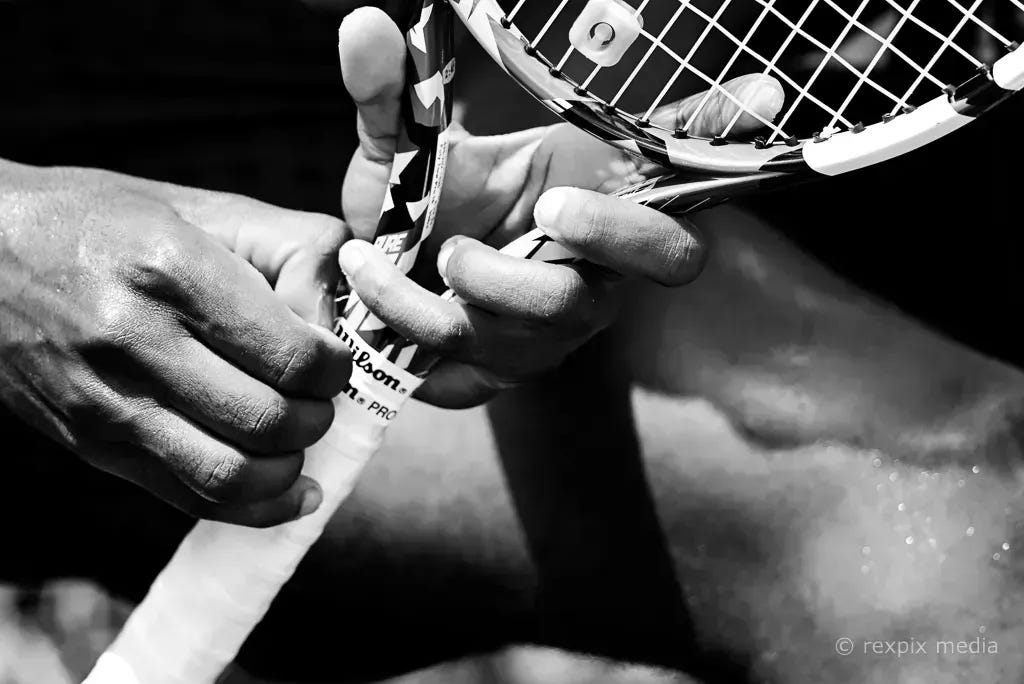
Then Jelani showed up in Lynchburg, Virginia, at the backyard court of Dr. Robert Walter Johnson, a true icon of Black tennis history and a member of the International Tennis Hall of Fame.
For the film, we had Jelani playing with a 1950s wooden racket and some pretty dead tennis balls — the only white balls I could find. He got on court, hit two balls…
And I remember thinking: Geez. This kid is good. Really good.

Jelani was 15 and went on to complete an outstanding junior career, competing internationally and playing the US Open Juniors. And now we were asking him to portray Arthur Ashe on the very backyard court where Arthur had spent his summers from ages 12 to 17.
Dr. Johnson helped develop Arthur’s game there, but also mentored his discipline, ethics and approach to life. Althea Gibson had trained there before him. Jelani had to become Arthur Ashe — not simply imitate his strokes, but inhabit him as a young tennis player and as a young man.
Eight years later, I went to Washington to photograph Jelani again. The kid I remembered as a very good 15-year-old has become an exceptional college tennis player and an extraordinary athlete.
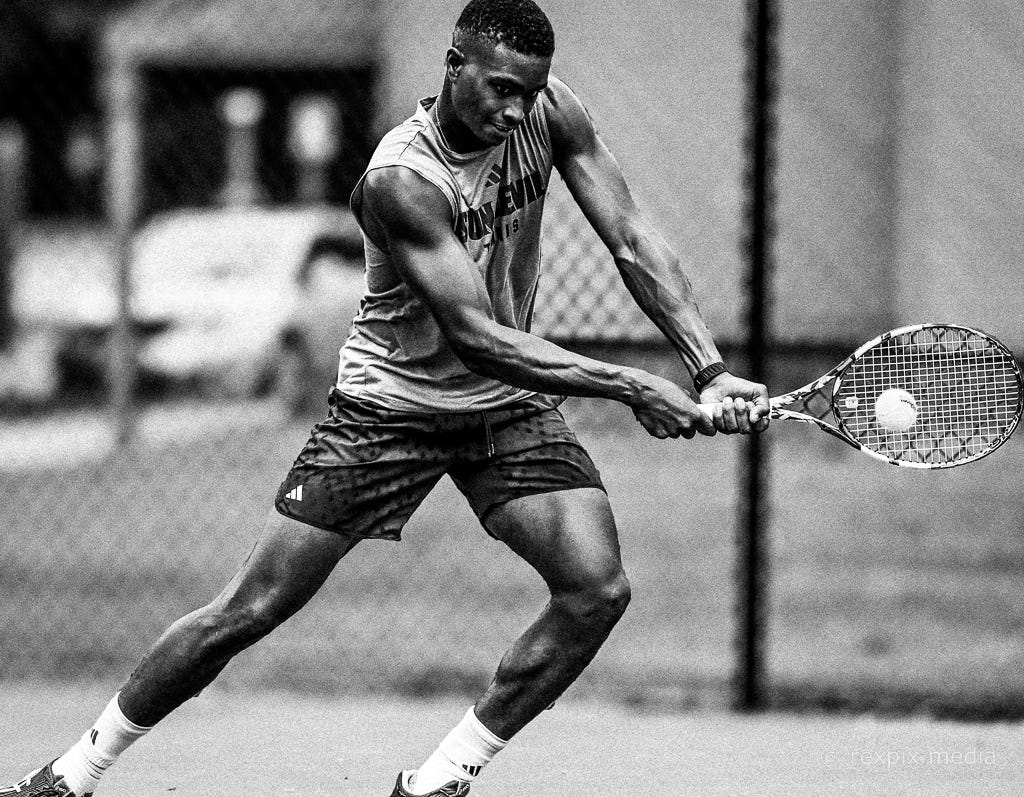
He’s now a standout D- player at Arizona State on full scholarship. He has a world ranking. He’s entering his senior year, and when it’s over, he will take his shot at professional tennis full time.
What struck me photographing him again was just how good he has become. Powerful. Explosive. Beautiful technique. Incredible physicality. He is also a young man who is grounded and mature, who understands that he’s approaching an important moment.
And here’s the crazy thing about tennis:
Jelani has already made it in ways that 99.9% of tennis players never will — elite junior, D-I scholarship, world ranking. Jelani is this good and he’s still a long way from the top of professional tennis.

I’m fascinated by that extraordinary gap between being this good and being one of the tiny, tiny number who can make a real living playing professional tennis — which means top 50 in the world.
That’s not a reflection on Jelani. It’s a reflection of just how competitive this sport is, and college tennis today is its own extraordinary world of elite international players. Most players are from other countries. Most have world rankings and professional aspirations and want to play Wimbledon, the US Open and make millions. Everybody is really good.
For Jelani, there’s another year at Arizona State — another year of high-level competition, with coaches, trainers, great sports medicine support and the major resources of a the ASU program behind him.

He’s also working hard academically and intelligently building relationships throughout the larger world of tennis. He’s thinking not only about the opportunity immediately in front of him, but about where the game might take him.

Then he’ll take his shot.
Eight years ago, Jelani’s job was to become Arthur Ashe. He doesn’t need to do that anymore.
He’s Jelani Sarr. Now comes the interesting part.
What happens when somebody expands what’s possible?
photos by Rex Miller
Rexpix Media rexpix.com

He might have looked good in Wilson, but Alex de Minaur can certainly accessorise a Porsche.
RALLY SMASHES: Ralph Lauren + Alex de Minaur
Alex de Minaur (ATP No. 8) may not be the highest ranked player but among brands, he is the hottest thing going. After his and Katie Boulter’s fairy tale summer wedding, during which he drove his bride away from an English country pile in a vintage Porsche, men’s fashion designers can’t seem to get enough of “The Demon.” Even a classic designer whose bread and butter is not down-under Outback, but red-white-and-blue Hamptons: Ralph Lauren. Nonetheless, after some horse trading with Wilson earlier in the year, de Minaur will now join Ralph Lauren as its second (yep, second) player ambassador, according to Jessica Schiffer of Hard Court. Ralph Lauren already had deals to don all the officials and support staff of three of the four majors for more than two decades and also outfitted the American Olympic teams. Why start sponsoring these fickle players? De Minaur has the “kind of image brands rarely have to worry about managing: friendly and charismatic, polished without seeming overly cultivated.” Let’s hope de Minaur does better than 19-year-old American prospect Scott Oudsema, who peaked at No. 145 in the world — Ralph’s first pick in the early aughts.

Sasha Zverev managing his diabetes during the Wimbledon final — a condition he has managed since a child, but only recently revealed.
RALLY SHANKS: The “Anyone But Zverev” Campaign
Since 2019, Alexander Zverev has been dogged by three things: his mercurial nature, his inability to follow direction from anyone outside his family and allegations of domestic abuse brought by a journalist named Ben Rothenberg. The problem: Rothenberg’s original reporting didn’t have a neutral or third-party source, Zeverev sued for slander and seven years on, the case continues. The latest: the “#anyonebutzverev” campaign launched about the time it looked as if the beleaguered Zverev make make a Slam final. For both the French and the Wimbledon finals, which Zverev won and lost respectively, Rothenberg made the same appeal. In the meantime, Zverev has cleared ATP investigations, resolved one dispute with the mother of his child and resumed joint custody of his daughter and had carried on a relationhship with a Russian media figure since 2021. Meanwhile tennis’ other bad boy has been done again for cocaine after he received a slap on the wrist for abuse charges in Australia.
One possibility unreported in any media: Zverev has suffered from Type One diabetes since childhood. Anger issues in Type 1 diabetes are linked to blood sugar swings and when these glucose levels spike or crash, stress hormones like adrenaline trigger sudden irritability, frustration, or “diabetic rage”. The relentless daily burden of managing the condition also wears down emotional resilience. But most people just want to focus on Zverev’s tennis these days.

A view of the seven red clay tennis courts from the front porch of the Arlington Players Club in Kearny, New Jersey.
TENNIS CLUB OF THE WEEK: The Arlington Players Club
Originally founded as a theatre club, a group of local thespians eventually ceded their clubhouse and grounds to group of tennis enthusiasts in 1909, as the new lawn tennis sport swept the country. First used by the Brits to protect grass courts from heat and wear on the French Riviera, crushed terracotta from local factories — a durable and readily available material — eventually became the go-to for Europeans. Arlington Players Club is now one of the oldest active red clay tennis clubs in the States, with seven assiduously maintained red clay courts, which the club attests offer “… a softer surface that allows for longer rallies, better control, and less strain on the body.” (A few of the pros who slip and slide during the run-up to the French Open might disagree with that last point.) For clay lovers, however, APC hosts the prestigious New Jersey National Red Clay Championship, drawing top players the Mid-Atlantic region.



BY Adrian Brune
READING TIME : 10 MINUTES
Related articles…
NCAA International Tennis Athletes v. the New Anti-Immigrant American Zeitgeist
Rally Report
BY Ana Gabriela Canahuate Torres
READING TIME : 8 MINUTES
Losing the Line Umpires + Ask the Buttery
Rally Report
BY William “Bill” Coles
READING TIME : 5 MINUTES
11 September 2026: 25th U.S. Open 9/11 Editon
Rally Report
BY Adrian Brune
READING TIME : 8 MINUTES
SEE ALL RELATED ARTICLES
Same author
NCAA International Tennis Athletes v. the New Anti-Immigrant American Zeitgeist
Rally Report
BY Ana Gabriela Canahuate Torres
READING TIME : 8 MINUTES
Losing the Line Umpires + Ask the Buttery
Rally Report
BY William “Bill” Coles
READING TIME : 5 MINUTES
11 September 2026: 25th U.S. Open 9/11 Editon
Rally Report
BY Adrian Brune
READING TIME : 8 MINUTES
SEE ALL ARTICLES BY THIS AUTHOR