
Rally Report
The Iraqi Player Rising through American Ranks
The first known native Iraqi to play tennis for an American college since the war, Mohammed Abuzed is battling for his D-1 dream
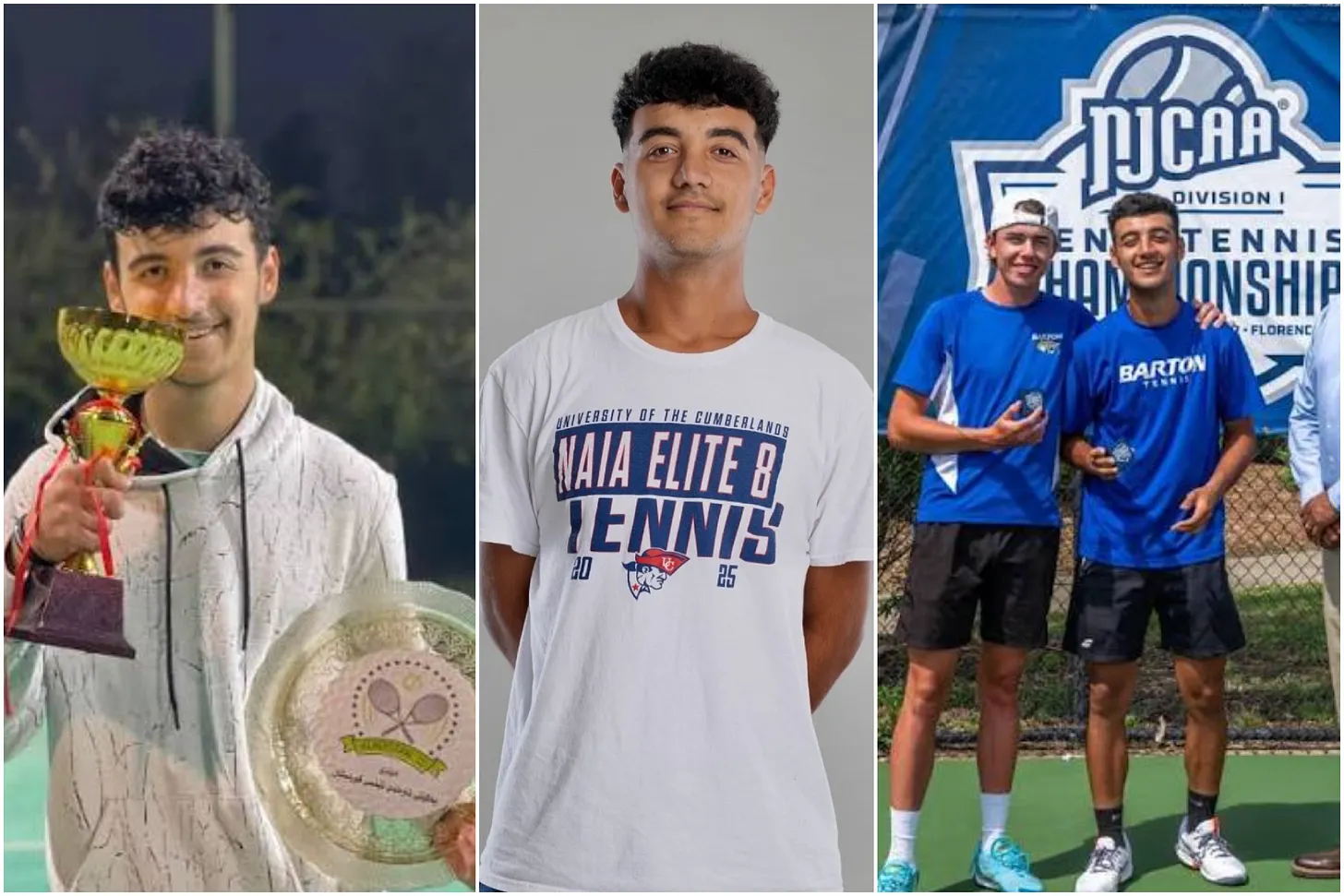
Kurdish player Mohammed Abuzed Saber, the first player from Iraq to compete on the U.S. College scene since the War in Iraq (2003-2017).
It was a stroke of luck, kismet, divine intervention or simply right place, right time. But without those 30 short minutes two years ago, Kurdish player Mohammed Abuzed Saber might never have become the first Iraqi to compete in U.S. collegiate tennis since the Iraqi civil war began in 2003.
Twenty years after those first bombs dropped in Baghdad, Saber, 25 — born two years after the war began — had just arrived home from his usual tennis practice at Peshmarga Park, when his younger sister burst through the family’s front door. “She said ‘come, come, get your racquets. There is an American around the courts,’ and she told me to show him how I could play; that I could possibly go play there,” Saber said in a phone interview from Texas, where he spent the summer teaching at the John Newcombe Tennis Ranch. He took her advice, something clicked and before a few months went by, Saber was landing on a cold, snowy, desolated Kansas runway on his way to Barton Community College to play NJCAA tennis and thus, on the first step of his dream: to play NCAA D-1 Tennis.
Since that January, Saber has overcome “such high stress against people I thought were better than me,” increased his level of play and helped Barton to a 16-8 record, a 2025 national runner-up finish at the NJCAA Division I Men's Tennis Championship and then to the NAIA National Championships Division I quarterfinals after transferring to University of the Cumberlands in Kentucky. “It’s my sister I have to thank,” he said.

Mohammed Abuzed Saber, a college student from Erbil, Iraq, plays a match at the University of the Cumberlands in Kentucky — an hour away from Mason, Ohio, the site of the U.S. Open tune-up, the Cincinnati Open.
Although under the administration of President Donald J. Trump the Department of Homeland Security specifically eliminated Harvard’s access to the U.S. student-athlete visa program in May 2025 — threatening to literally wipe out the college’s 42 varsity teams — the decision had far-reaching implications for students from so-called “undesirable” countries. It effectively paused all student visa interviews, resulted in country-specific travel-bans for recruiters and turned back athletes at the airport gate, making it virtually impossible for students from nearly 20 nations to compete in American college athletics. Nonetheless, a small number of tennis players from the Middle East, including Iraq, Jordan and Syria have still managed to climb the heights of the college ladders.
“I was thinking (when I landed) that I won’t be able to see my family for a while, that I’ll be far away for a maximum two months, if not longer,” Saber said. “At the beginning, I was nervous and not very happy, but slow, slow, I started thinking to be successful in my career and that I have been dreaming of a better opportunity and this is my time.
“Since I am here, everything has been ok,” Saber said. “Most Americans, and the families at the University of Cumberlands have been really kind. They seem happy that we’re here. “

Fans lining up on the gangway from the 7 Train and the Long Island Rail Road to attend one of the events during fan week.
More on Mohammed, but first… the news
The second year of the US Open’s three-week tennis residency in Queens, featuring the Mixed Doubles championships, the Savannah Bananas performing, Dad’s Mixed Doubles with Alex Eala, Iva Jovic, and their dads, as well as a gallimaufry of other events seemed to have the USTA’s intended effect: more bums in seats and tennis newcomers swirling around the Billie Jean King campus at Flushing. But the party came with a pricey hangover: unaffordable tickets, thanks to the secondary resell market in the US and corporate sponsors, such as Ticketmaster and American Express. If players and pundits weren’t waxing on about the good ol’ days when you could get a grounds pass for $65 and a Honey Deuce for $10, they were grousing about the redesign of the towering, sinus-clearing Arthur Ashe, which grabbed seats from the tippy-top and brough them Court side for more corporate play time.
The US Open is a boon for New York, however, injecting $1.7 billion into the city economy — a far more significant amount than the marathon weekend, the Mets entire season and definitely, the Jets football team — even if Mayor Mamdani snatched up 1,000 tickets for $100 each and gave them away. The USTA can also defend itself by saying that by far — more than any national tennis association — it pumps more money into spreading the game, especially for disadvantaged children. Anyone who looks at the Top 25 of either the WTA or the ATP rankings will see how well that has paid off.

Czech pair of Karolína Muchová and Jakub Menšík defeated Belinda Bencic of Switzerland and Flavio Cobolli of Italy in the revamped U.S. Open mixed doubles final.
Another side effect: the circus. “Consider the thing that does not know what it is: The United States,” writes Own Lewis in Air Mail. “Most people in the 20s, The humble croffle. A tennis event might be high on that list — make the draw, sell the tickets, let the players scythe each other down until there is a winner…. But on any given day, the U.S. Open is also a lifestyle brand, an alcohol hotbed, an oven disguised as a park, a gathering of the famed, the site of a short-lived dating show that had nothing to do with tennis…. promoted on the Open’s YouTube channel and a few further spots down the list, one of the biggest tennis tournaments on earth.”
Many people come to New York to find themselves, and one day, the U.S. Open may yet discover its drumbeat. Until then, hopefully the players won’t be too tired from all the mayhem to actually compete.
Back to Iraqi/American Tennis…

The Iraqi Davis Cup Team, including Mohammed Abuzed Saber, far right. The country is still rebuilding its team from a devastating ISIS attack in 2006, which killed three out of four team’s members, as well as the coach.
The son of a sports science professors at Hawler University and a full-time mom, Saber has been on a court of some kind since birth in 2005. Although a basketball player, Saber’s father switched over to tennis and started playing with Saber when he turned age five. Every day, they would head to Peshmarga Park — the best tennis courts in Erbil — and drill. When he surpassed his father’s capability, Saber started training with Naser Mahmood, a former pro and Davis Cup tennis player who soon made it his mission to keep tennis alive in Kurdistan. Along with a mixture of eight other girls and boys, despite the civil war and the Da’esh incursion coming within sometimes 20 miles outside Erbil, the kids practiced two to three hours a day — 30 minutes when the bombs and gunfire were especially heavy.
Playing tournaments, besides the occasional club or regional championship was pretty much out of the question for years — or done in quiet. On 25 May 2006, Al-Qaeda, following a radical fatwa issued against wearing Western sports attire or participating in any Western sports, assassinated the coach of the Iraqi national tennis team, Hussein Ahmed Rashid, and two top players, Nasser Ali Hatem and Wissam Adel Auda, outside the Alwiyah Club in Baghdad. The incident decimated the small tennis community in the country whose leading players were once among the strongest in the Arab world and took out the place where different religious, political and social factions could cooperate and even collaborate. Despite the psychological trauma, safety threats, and lack of training facilities — the courts near Baghdad’s Al-Shaab stadium had long been taken over by the U.S. Army — surviving player Akram Mustafa Abdulkarim spearheaded an immediate effort to revive the Davis Cup team, which played the following year against all odds.
“There is no chance for any of these boys to come close to turning professional,” said Luis de Sousa, a Portuguese coach who works with the International Tennis Federation in the Middle East, in 2014. “They’re natural athletes but the facilities and coaches in Iraq are very poor. Most of the good coaches have now fled.”

Mohammed Abuzed Saber playing Group IV Asia/Oceania Davis Cup in 2024, before he came to the U.S. Without ease of entrance and exit to his university, Saber cannot risk leaving the country.
Some coaches may have taken off for safer ground, but many players across the country dug in. Once ISIS was eviscerated and some degree of normalcy resumed in both the Federal Republic of Iraq and the Kurdistan Regional Government, Saber and his tennis mates started traveling more and more to Kuwait, Turkey and even Iran to play tournaments. Still, without money for academies in other countries, even the Rafael Nadal Academy in Kuwait, American universities provide practically the only way for players from war-torn and economically beleaguered countries, to pursue their tennis dreams — the U.S. Open, for example, saves at least two wildcards for college champions.
“Since I am young I have always wanted to be a good player; I want to be the first guy from Kurdistan to go pro, and I have been dreaming to represent Iraq,” said Saber, the youngest player from Kurdistan in the history of Iraqi’s Davis Cup team. But of late, Padel, a cross between squash and tennis that uses a racquetball-sized solid bat, has captured the imagine of most of the Middle Eastern would-be tennis or squash associations — and even a good deal of coaches.
“When I go to Texas, I could play a tournament every week, in Iraq or Kurdistan, I have seen, really, a lot of good players, but there’s no support,” Abuzed said. “Football is popular in every town — every town has a pitch.
“Now, Padel is taking over the tennis courts and because of Padel, every tournament there is prize money. My national team friends are playing Padel and that make tennis get weak. The businesses are supporting Padel, but no businessman supports individual players to travel, to train. It’s just you, God and family.”
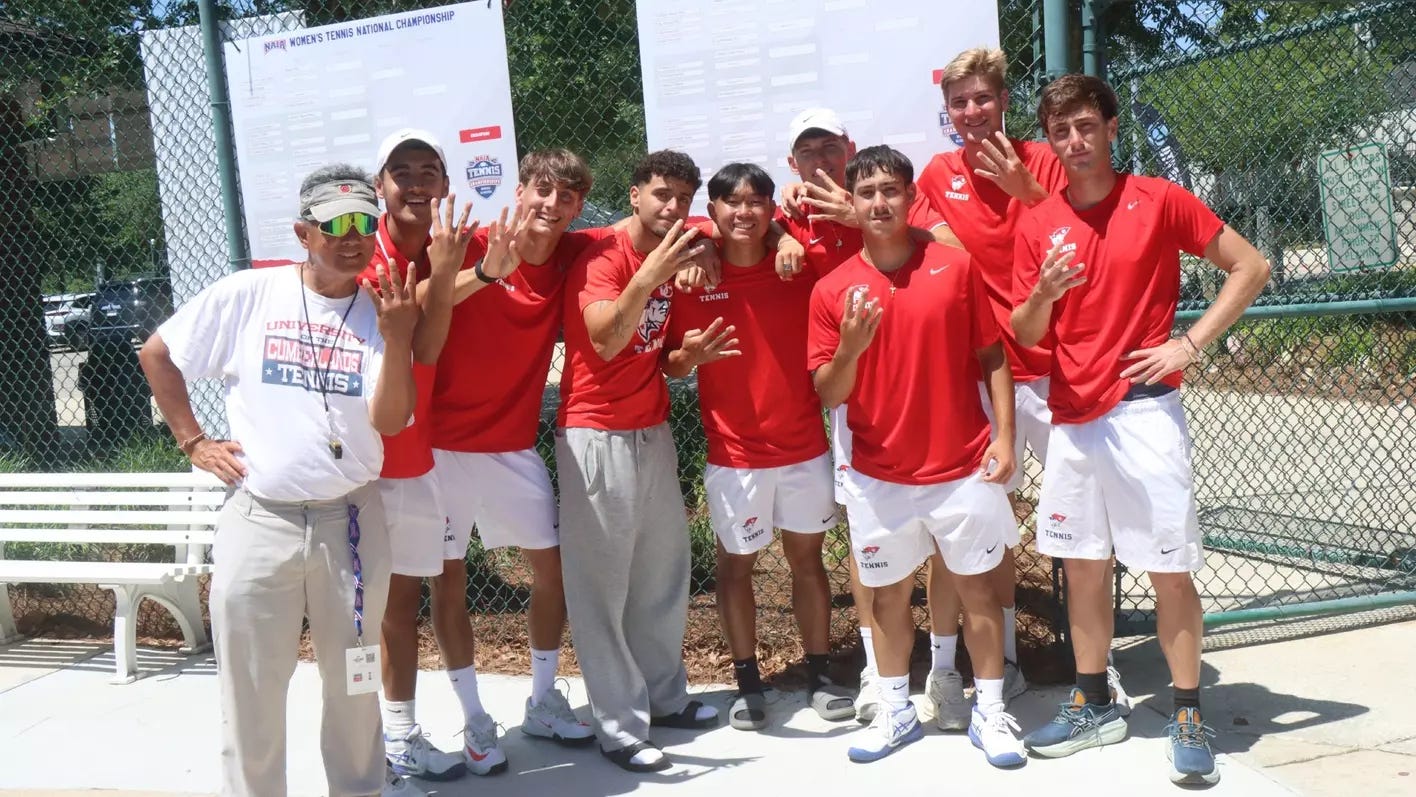
Mohammed Aubzed Saber (far left) and his University of the Cumberlands teammates celebrating their deep run into the NAIA championships last May.
Only three players from the Middle East have been recruited to play tennis for American universities in recent years — Michigan State junior Taym Alazmeh from Syria and former University of Florida player Abdullah Shelbayh from Jordan — and both have excelled. Just this past weekend, Alazmeh helped Team Syria to a historic win over Ireland and advance in World Cup Group II (Jordan’s greatest Davis Cup achievement to date) and in 2023, Shelbayh became the first Jordanian tennis player in history to secure an ATP world ranking and win an ATP Challenger title.
Saber sees their success, celebrates it, and like any good tennis competitor, desires to emulate it.
“The guy I played (at the NAIA quarterfinals), two years ago, I would have lost 0-0, and this year, I nearly beat him,” Saber said. “If you’re out there all alone, other players might have lost and feel bad about themselves — not want to play again —but college tennis is loud between points; people cheer; you get mentally and physically stronger.”
“I see it happening with me. For sure, I miss my home and I would like to go back someday. But my opportunities are here right now.”

RALLY SMASHES: The Player’s Box Pod
With every tournament there seems to be a new podcast or Substack about tennis stats, tennis fashion, tennis culture, tennis… and although many try to give the inside view of the locker room, most can’t. Or can’t do it so humorously or with such joie de vivre as the four players and friends of The Players Box. Having trained together, traveled together, played World Team Tennis, as well as Billie Jean King Cup together for the past 15 years, Jennifer Brady, Jessica Pegula, doubles specialist Desirae Krawczyk and Madison Keys, not only know the inside-outs of each other’s games, but also each other’s nicknames, pet-peeves, favourite foods and racquet bag mascots. They don’t pull punches, either, whether poking fun at the American men’s “court-walk” outfits or weird English foods. Have a listen, have a laugh, and revive that childhood dream that you’re a top-ranked tennis player, traveling around the world with your besties and killing tennis balls, as well as the radio waves.

A magazine insert published in 2022 by Racquet, two years after reporter Ben Rothenberg wrote an expose of Alexander Zverev’s alleged domestic violence. Rothenberg was sued by Zverev and has since increased the volume on Zverev’s settled allegations with an “Anyone but Zverev” campaign.
RALLY SHANKS: Anyone But Zverev Campaign
Unequal prize money. Better court and practice times. Constant scrutiny on looks and attitude. The patriarchy is still alive and well in tennis, and domestic abuse among certain players against their partners still happens. In May 2020, Nikoloz Basilashvili (ATP No. 132) was arrested in Tbilisi, Georgia and charged with committing physical violence against his ex-wife in front of his son. In 2023, Australian bad boy and wunderkind Nick Kyrgios pleaded guilty to shoving his ex-girlfriend in 2021 and thus had an assault charge dismissed by a magistrate. But none have been summarily vilified like Alexander Zverev, who in 2020, was accused by then Racquet-magazine contributor Ben Rothenberg of assaulting his then-girlfriend Olya Sharypova, a former tennis comrade, in a New York City Hotel during the 2019 U.S. Open. Zverev sued for defamation; Racquet fell apart; and Rothenberg keeps poking that bear as the German continues to find his form after ten years in the spotlight. The latest: The Anyone But Zverev Campaign he launched when the ATP No. 2 made it to the French Open final and carried over to the Wimbledon final.
Even before Rothenberg’s Substack post, he and others have already convicted the German in the court of public opinion, although Zverev’s domestic woes have long been settled — all but one: the defamation case against Rothenberg in Germany for which he raised $35K after promising to give anything above $22k to a domestic violence shelter. Wherever the player goes, he is still heckled and harassed, and no journalist has looked into the possibility that even though Zverev is known as mercurial on tour, he suffers from Type I diabetes, which causes rage and sometimes uncontrollable anger if sugar levels suddenly drop. Although nothing excuses violence against women, all three men are mere symptoms of a society that still views women less than, and Rothenberg, while presenting himself as a feminist champion, wrote for Racquet when it was publishing up-skirt, sweaty, wet t-shirt photos of female players in the New York summer. Until the social disease of objectification ends, the symptoms will continue. Mostly, however, tennis fans just want to move on.

Stefanos Tsitsipas practicing on the grounds of the U.S. Open before the start of the tournament.
NOTES FROM A CINEMATOGRAPHER: Rex Miller, The Althea Effect
What if winning can get in the way of getting better?
Stefanos Tsitsipas, part 1
I recently spent some time photographing and talking with Stefanos Tsitsipas.
Stefanos has been one of the best tennis players in the world — ranked as high as No. 3, a two-time Grand Slam finalist, and one of the most recognizable players of his generation.
He's at an interesting point in his career.
Earlier this summer, his ranking had fallen to No. 87 — his lowest in more than eight years. He’s now working his way back, currently at No. 49.
He is, in every sense, a work in progress.
There has been plenty written about Stefanos and coaching — particularly the complicated, sometimes turbulent relationship with his father, Apostolos, who has coached him for much of his life. I wasn't interested in asking him about any of that.
Instead, I asked him to imagine something:
"Stefanos, someday, maybe you'll coach. If you had a 12-year-old kid and someone said, 'Stefanos, take this kid for the next five years,' how would you approach it?”
Words and pictures by Rex Miller

New York Mayor Zohran Mamdani hits a backhand with kids from the NYJTL program after opening 10 refurbished courts in Crotona Park, now part of the Cary Leeds Center. Lower right: the old Crotona Park tennis house, which remains in use.
TENNIS CLUB OF THE WEEK: Cary Leeds Tennis Center
Even before Everybody’s Mayor Zohran Mamdani cut the ribbon on 10 newly resurfaced, professional-grade NYC Parks tennis courts in Crotona Park and doled out 1,000, $100 tickets to the U.S. Open, the Cary Leeds Tennis Center has been a tennis fixture in the Bronx. Constructed in a public/private partnership with the NYC Department of Parks and Recreation, Cary Leeds opened in 2015 to wide acclaim as the home to New York Junior Tennis and Learning, a program that merges after-school programming with tennis instruction and competition on afternoons and weekends. Situated next to the old Crotona Park tennis courts — the only public tennis courts in the Bronx with lights for night play — Leeds had 12 refurbished courts, including a Stadium and Grandstand, as well as a 12,000-square-foot clubhouse. Now it has 22 courts and even more room for New York’s future tennis stars.



BY Adrian Brune
READING TIME : 8 MINUTES
Related articles…
NCAA International Tennis Athletes v. the New Anti-Immigrant American Zeitgeist
Rally Report
BY Ana Gabriela Canahuate Torres
READING TIME : 8 MINUTES
Losing the Line Umpires + Ask the Buttery
Rally Report
BY William “Bill” Coles
READING TIME : 5 MINUTES
11 September 2026: 25th U.S. Open 9/11 Editon
Rally Report
BY Adrian Brune
READING TIME : 8 MINUTES
SEE ALL RELATED ARTICLES
Same author
NCAA International Tennis Athletes v. the New Anti-Immigrant American Zeitgeist
Rally Report
BY Ana Gabriela Canahuate Torres
READING TIME : 8 MINUTES
Losing the Line Umpires + Ask the Buttery
Rally Report
BY William “Bill” Coles
READING TIME : 5 MINUTES
11 September 2026: 25th U.S. Open 9/11 Editon
Rally Report
BY Adrian Brune
READING TIME : 8 MINUTES
SEE ALL ARTICLES BY THIS AUTHOR