
Rally Report
The London Pride Edition: Gay and Lesbian Tennis Alliance (International GLTA)
Before the gays were here, queer and getting the Brits used to it, there was the GLTA + British hopes dashed (again) + AELTC News
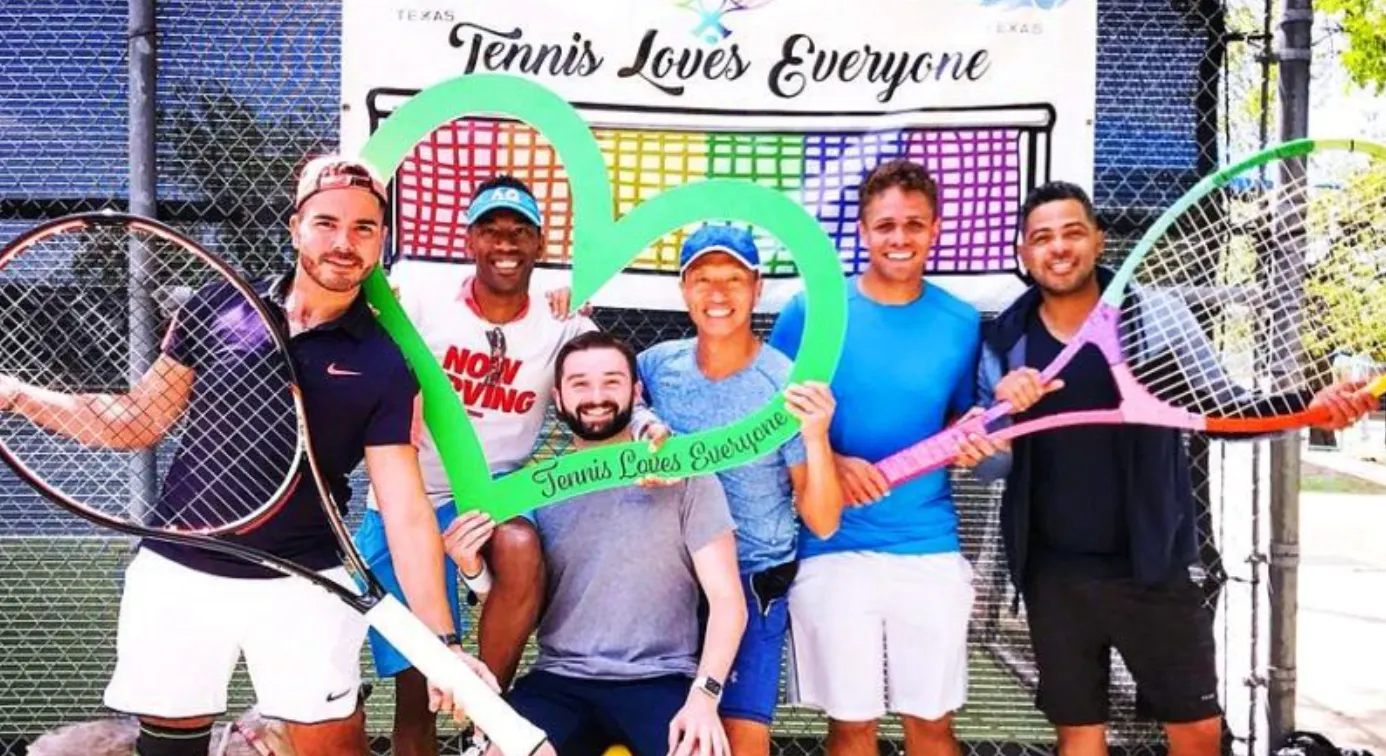
Members of the GLTA pose for fans under their theme: Tennis Loves Everyone.
Gottfried von Cramm was in a jam. The German Baron — known as one of the kindest, fairest men on tour in the decades between World Wars I and II — had been hailed as a champion by Hitler and the Nazis in the early 1930s after he won the French Open twice and brought glory to his country in Davis Cup play. But in 1937, der Führer increased the pressure. After the humiliation at the hands of Black American, Jessie Owens, during the 1936 Berlin Olympics, the German chancellor wanted a tennis victory over the Americans: the Davis Cup Interzone Final — the match that would, essentially, amount to bringing home the trophy. Moments before American Don Budge and Cramm walked onto the court, Cramm received a phone call. Hitler, on the other end, wished him “good luck” — code for “you’d better win this.”
Cramm didn’t, despite his fellow gay pal Bill Tilden coaching the Germans. The following year, the Gestapo caught Cramm locking lips with a gay, Jewish actor and jailed him for six months before the German Army conscripted the convict. He unwillingly fought for the Nazis, a government in which he never believed. But two friends still backed Cramm: Don Budge and Bill Tilden. After Budge, a straight guy, helped free Cramm, Tilden helped restore his game. Unable to compete at Wimbledon until 1951 for his conviction on “morals charges,” as well as the U.S. Open thanks to the black mark on his visa, Cramm spent the last years winning German national titles and playing Davis Cup until 1953, when his friend and mentor, Tilden, died of heart complications, age 60. (Cramm perished in a 1976 car accident in Egypt.) Their lives made for great books, movies and documentaries, however, including the 2009 book A Terrible Splendor: Three Extraordinary Men, a World Poised for War, and the Greatest Tennis Match Ever Played; a 2011 BBC Radio 4 radio play, Playing for His Life; the 2023 Netflix documentary Eldorado – everything the Nazis hate; and the 2024 PBS documentary, Playing to Survive: von Cramm vs Hitler.
While much has changed for LGBT players in tennis, largely thanks to Billie Jean King and Martina Navratilova — outed in the 1980s — a 2022 ATP Tour survey found that 75 percent of players reported having heard other players use homophobic slurs. The survey also indicated a “strong fear of rejection, isolation from others on tour, and loneliness” as being likely barriers to LGBT+ players’ public disclosure of their sexual orientation.

The LGBT Pioneers of tennis, clockwise from top left: Helen Jacobs, Bill Tilden, Gottfried Von Cramm, Toupie Lowther, Dr. Renée Richards and Rosie Casals.
Too bad, the Gay and Lesbian Tennis Alliance (GLTA), a global LGBT sports association that sanctions over 70 competitive tennis events across the globe each year, hadn’t organised earlier. In fact, it would take more than 15 years after Cramm’s death for amateur gay tennis players to pull together, although the exiled baron certainly knew of the Stonewall riots and quite possibly the smaller collectives forming in Dallas, Los Angeles, San Francisco and Houston in the late 1970s. By the early 1980s, however, lesbians and gay men were playing an informal circuit, their groups holding tournaments that drew players for LGBT community, culture and competition from around the U.S. In 1991, after coalescing around the Third Gay Games held in 1990 in Vancouver, the GLTA formalised.
“They just wanted to play tennis, be themselves, and not be judged for being gay,” Dan Merrithew, one of the original seven GLTA members, told We Are Tennis magazine. “We even host tournaments in countries where homosexuality was still a crime ten years ago.
“Our players now play on the most impressive tennis courts in the world, like the US Open or the Australian Open courts, as well as on many other ATP and WTA courts. Also, the number of tournaments and participants keeps growing.”
More on the GLTA, but first… the news
Breaking
The WTA announced today that due to the continuous war in Iran, it will move its year-end WTA Finals event to Indian Wells, effective immediately, while searching for a new semi-lasting venue. Rally wrote about the conundrum a year ago.

Emma Raducanu leaving the Aorangi Park practice courts at the AELTC last week. Even then, the “niggle” in her shin was becoming headlines.
The Brits: Still Seeking a Contender
During the massive heat wave (well, massive for England) that struck Europe last week, the Brits kept calm and carried on, playing their various exhibitions, tune-ups (Eastbourne) and Wimbledon qualies. Like a well-tuned Bremont, the English media started speculating on which British player would bring home the Venus Rosewater dish or the Gentleman’s Singles Trophy. Would it be a resurgent Emma Raducanu (WTA No. 33) who made it to the final at the women’s HSBC Queen’s Club Championships just two weeks prior? Or the die-hard Jack Draper (ATP No. 131), who surged to the Eastbourne semifinals on his first run back in four months?
It would be neither. At beyond the 11th hour, Raducanu pulled out on Sunday night with a stress fracture — it made the top of the headlines Monday morning. To deliver the double shock (on Sunday, he gave interviews to practically everyone), Draper announced his withdrawal due to the resurgence of the shoulder injury that plagued him four months prior. The rest of the day proved just as devastating with all of the English women wildcards, save Katie Swan (WTA No. 196), crashing out in the first round, along with four out of the six men’s. Only Jacob Fearnley (ATP No. 159) and Arthur Fery (ATP No. 114) managed to push through), giving Brits some hope.

A tearful Stan Wawrinka waves goodbye to his adoring fans at Wimbledon. “I don’t want to retire but I know it is time for me to stop. One of the reasons why I kept playing for so long was to enjoy the moments like tonight,” he said post-match.
With much ado about — in the end — nothing, Serena Williams (unranked) snatched up that last Wimbledon wildcard at the last minute, leaving us all in feigned suspense that Williams would ever turn down a challenge. Earlier tonight on Centre Court, she took on Australian Maya Joint (WTA No. 87) who has lost 13 out of her 14 last matches and dropped 37 spots in the rankings last week. Despite the 24-year age difference and the advances in conditioning, recovery and equipment after Williams “retired” in 2022, pundits still had Williams winning over Joint. But all seemed to have discounted how much fitness the body loses with age and if not playing matches for four years. Williams pushed her contest to a third set after Joint lost some nerve — and blew two match points. Still, Serena ran out of steam, as well as dominant serves, in the third set and Joint’s angles proved too much. Olympia Ohanian, Serena’s daughter, watched Joint deliver the final blows around 10pm BST 6-3, 6-7 (8-6), 6-3.
Over on Court 1, it was a match of tiebreaks that nearly went to five sets as the 30-year-old Matteo Berrettini (ATP No. 51) took on a 41-year-old — and retiring — Stan Wawrinka (ATP No. 109). Wawrinka, who had never left the tour but remained selective about his schedule, looked as if he could easily handle Berrettini winning the first set tiebreak 7-6 (9-7), but then saw his momentum fail by a matter of millimetres over the next three sets. Berrettini, who has also struggled with injury over the past year, prevailed in the end, winning the next three sets 7-6 (18-16), 7-6 (9-7), 7-6 (7-5). Both men — either in tears or on the verge of them — said a long goodbye, after the Italian ensured his Swiss counterpart received his final Wimbledon match towels.

Pete Sampras defeated Patrick Rafter 6–7 (10-12), 7–6 (7-5), 6-4, 6-2 to win his seventh and final Wimbledon title in 2000 — the last American man to hold the cup.
First Round Surprises — and Bracket Busters
Despite Casper Ruud (ATP No. 12) and Andrey Rublev (ATP No. 13) going out in the first round, the men’s bracket remains unpredictable, as both Jannik Sinner (ATP No. 1) and Alexander Zverev (ATP No. 2) make their way at opposite ends of the bracket to squish Novak Djokovic (ATP No. 8) as he plows through the middle seeking his 25th Grand Slam title. Today, seven Americans, including Tommy Paul (ATP No. 25), Lerner Tien (ATP No. 17) and Brandon Nakishima (ATP No. 31) become the closest thing to an Englishman to win the championship, a feat that has not happened since Pete Sampras took the title in 2000. Six American women will join them in their quest for the title, including Jessica Pegula (WTA No. 4), Coco Gauff (WTA No. 7), and Iva Jovic (WTA No. 16) as they push through their second round matches (that is, if Queen-killer Tatjana Maria (WTA No. 96) doesn’t destroy Jovic with her neutralising slice). One notable match and player on the move: Zeynep Sönmez (WTA No. 51), a 24-year-old Turkish player steadily climbing the rankings and quietly moving from the backcourts to the show courts, much in the way as her MENA predecessor, Ons Jabeur.

Two GLTA doubles players showing off their hardware in 2019.
Back to the Loud + Proud GLTA…
With some of the most decorative trophies and punniest names known to the tennis world, (North London Lobsters, Capital Tennis Group in DC) in less than 20 years the GLTA grew from five tournaments to more than 80 across the globe in 2010. An estimated 10,000 players participate in GLTA tournaments each year, with the draw ranking in size from fewer than 100 competitors to more than 400 duking it out within divisions determined by ability, from Open to Level D. While local GLTA associations and clubs arrange the tournaments, the GLTA provides technical support, governance and direction. Each tournament raises funds for the cause chosen by the local association, usually related to LGBT+ issues.
In the spring of every year, the GLTA invites the top eight players in each of the five divisions to compete at the international GLTA World Tour Championships, usually taking place in a warm, European country. In April, two Texas teams — the Houston Tennis Club and the Oak Lawn Tennis Association in Dallas — dominated the championships held at the Marsa Sports Club just outside Valetta, Malta. « I feel like [GLTA players] have a recognition that the world is not always on our side,” said Arron Blackmon, a GLTA player from Texas. “So within the grounds of the tournament, it's more important for us to feel like there's a common respect among everyone.”
This year, the Crown London Championships will take place at the AELTC Community Tennis Centre in Raynes Park in Southwest London — a stone’s throw from Wimbledon itself — from 30 July to 2 August. Draw spots remain open, as do volunteer positions for armchair players, with time enough to recover from Pride and feel competitive again. “Knowing that all of you have something in common, being able to make references and jokes about things happening within our community or pop culture and everyone getting the reference makes [GLTA tournaments] extra special and a lot of fun,” Van Liew said.. “Having a space where we all can go and play and be our true selves is really important."

A flyer calling for entires and volunteers to make the Crown London Championships an event to remember.
Can’t make it to London for the Crown (allies always welcome), Prague, Berlin, Torino, Paris and even Columbus, Ohio will host tennis tournaments throughout July with the Metropolitan Tennis Group holding the Liberty Open — one of the most popular, and usually sold out tournaments — at the Billie Jean King Tennis Center, the site of the U.S. Open. At that big, luscious, manicured tennis court in the sky, Gottfried von Cramm, Tilden and the rest of the LGBT+ players throughout history are looking down and feeling fabulous.

The Metropolitan Tennis Group in New York gathers for Pride Day, held each year at the USTA Billie Jean King Tennis Center.

The Served Bracket Challenge features easy entry, fingernail-biting suspense and Andy Roddick’s and John Wertheim’s heads doing weird rotations. What’s not to love?
RALLY SMASHES: The Served Bracket Challenge
Since retiring from tennis, aged 30, in 2012, on might say Andy Roddick has been looking for a gig he actually liked. Likely approached for coaching and definitely sought-after for commentary, the funny, some may say slightly brash or bold — and definitely opinionated —player hadn’t found anything that quite fit his milieu. Until someone offered him a podcast. In the past two years, Roddick developed “Served”, produced by Roddick and sports television producer Michael Hayden, which now has more than 200,000 YouTube subscribers. “Served,” in which Roddick talks to top players or goes for the long rallies on the minutiae of competitive tennis, has risen to the top of the heap of tennis podcasts. To add to the fun, every Grand Slam, Served “chuckers” can go up against the man himself, along with Kim Clijsters of sister podcast “Love All” in the Served Bracket Challenge. While their are no prizes to speak of yet, the glory of besting the greatest non-pundit there ever was should satisfy every armchair baseliner.

Martina Navratilova and Chris Evert were friends first, then rivals, following Navratilova’s redirected ambitions. Friends again, they are now teammates in the fight to stay cancer-free.
RALLY SMASH 2: Chris + Martina: The Final Set
As a youngster, I grew up on NBC’s Breakfast at Wimbledon, Bud Collins’ colorful pants, and Martina Navratilova and Chris Evert duking it out nearly every Grand Slam Final. Chris and Martina weren’t exactly household names in my decidedly non-sporty, very bookish Oklahoma homestead, but my feminist mother and poet father always caved when we begged to watch these two play — secret fans, I’m certain. I could have never known that Chris and Martina had been such good friends — before Martina’s “bigger, faster, stronger” years — until I watched Chris + Martina: The Final Set, Netflix’s answer to finding another rivals documentary — only this time, for the women. Filled with flashbacks and hard-to-find footage (and even B-roll of the pair watching those matches together 40 years later), the documentary also — somehow — gained permission to trail both getting cancer treatment in New York and Florida (no, they didn’t do chemo together). My only beef: countless documentaries have been done on Borg + McEnroe, Roger + Rafa without any angle on intimate health, why did female tennis fans have to wait for both of these greats to get life-threatening cancer for theirs? Still, it’s a compelling look at how age and illness can humble the GOATs of the world, and even bring them closer together.

The Wimbledon Tennis Court in Central Park’s Wollman Ice Skating Rink (Photos by Gambrelle Snyder and Grand Pass).
TENNIS CLUB OF THE WEEK: The Wimbledon Lawn at Central Park
Every club in the London area vies for the title of first lawn tennis club, or oldest lawn tennis club, or most oak-paneled club, and almost always, Wimbledon takes the prize. New York has one or two of those around — the West Side in Forest Hills, the Town Tennis Club, The River Club and the Heights Casino — but nonetheless, the All-England Club wanted a bigger splash in New York this summer, rather than just the finals party on a fake Murray Mound in Brooklyn. Voila! Just grass over Central Park’s Wollman Ice Rink, grab a bit of Wimbledon memorabilia and install some stands and insta-Wimbledon, New York style. Last week, before they flew over the Atlantic for their commentating gigs, Andre Agassi and the newly minted pundit, Eugenie Bouchard, even turned up to play a couple of rounds. Here’s an idea: make it permanent. Waiting times at the Central Park courts are impossible and clubs are out of most New Yorkers’ price range. Wimbledon for the people!

Wimbledon large screen and deck chair viewing in Grovesnor.
Wimbledon Watching Spots Around London
Missed the maddening ballot? Can’t afford $550k for Debenture Seats? Not up for camping in SW19? Here are a few spots to kick-back, open a can (yes, they make every mix of alcohol in cans in England) of Pimm’s and sit back in a deck chair:
Centre Court-Yard: Soho hotel Ham Yard created a Centre Court in the city this to watch all the action alfresco sans queue.
Covent Garden Market: Don’t like Pimm’s. Want a little bit of U.S. Open seat-ninja action? Enjoy a cold glass of Champagne Lanson and argue with a tourist about who gets the deck chair first.
Portman Square Garden: In the Center of Marylebone, you can pose with the tennis poseurs in your finest flower dress and linen blazer. Sun hats mandatory.
Camden Market: The punk’s Wimbledon. Expect Nick Kyrgios to turn up for a beer and some kink.
Canary Wharf: Get your New York/U.S. Open skyscraper vibes just a few short months before the grand event.
Screens on the Canal, King’s Cross: For those who can handle the children, the shoppers, the architecture buffs and the tech bros.



BY Adrian Brune
READING TIME : 12 MINUTES
Related articles…
NCAA International Tennis Athletes v. the New Anti-Immigrant American Zeitgeist
Rally Report
BY Ana Gabriela Canahuate Torres
READING TIME : 8 MINUTES
Losing the Line Umpires + Ask the Buttery
Rally Report
BY William “Bill” Coles
READING TIME : 5 MINUTES
11 September 2026: 25th U.S. Open 9/11 Editon
Rally Report
BY Adrian Brune
READING TIME : 8 MINUTES
SEE ALL RELATED ARTICLES
Same author
NCAA International Tennis Athletes v. the New Anti-Immigrant American Zeitgeist
Rally Report
BY Ana Gabriela Canahuate Torres
READING TIME : 8 MINUTES
Losing the Line Umpires + Ask the Buttery
Rally Report
BY William “Bill” Coles
READING TIME : 5 MINUTES
11 September 2026: 25th U.S. Open 9/11 Editon
Rally Report
BY Adrian Brune
READING TIME : 8 MINUTES
SEE ALL ARTICLES BY THIS AUTHOR